
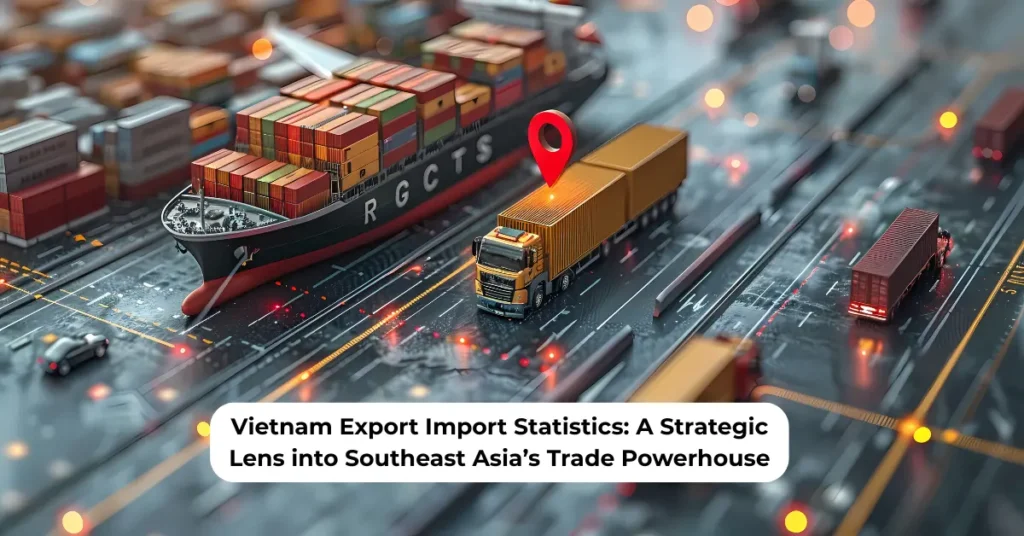
Decoding Vietnam’s Trade Momentum in a Rapidly Shifting Global Economy
Why Vietnam’s Trade Data Is Becoming the Compass for Global Investors and Exporters
In the grand theatre of global commerce, few nations have engineered a transformation as swift and strategic as Vietnam. Once primarily agrarian, today it stands as a manufacturing juggernaut and an indispensable node in international supply chains. The numbers tell the story. The momentum is undeniable. And the implications are vast.
The intricate tapestry of Vietnam imports and exports reveals more than mere transactional flows; it discloses structural shifts, geopolitical recalibrations, and a deliberate pivot toward high-value manufacturing. For investors, exporters, procurement heads, and policy architects, understanding Vietnam export import statistics is no longer optional. It is elemental.
Consider the arc of expansion. From textiles and agricultural commodities to semiconductors and advanced electronics, Vietnam’s export basket has diversified with astonishing alacrity. This evolution is not serendipitous. It is policy-driven, infrastructure-backed, and globally integrated.
The surge in Vietnam export import statistics 2022 underscores a resilient rebound following pandemic-induced contractions. Trade volumes accelerated as supply chains recalibrated away from overconcentration in singular markets. Multinational corporations reconfigured sourcing matrices. Vietnam emerged as a pivotal beneficiary.
Yet, to comprehend the full panorama, one must also revisit Vietnam export import statistics 2020—a year that tested economic fortitude worldwide. Even amid unprecedented logistical disruptions, Vietnam maintained positive trade performance, demonstrating structural resilience rather than cyclical luck. The data reveals a country not merely surviving turbulence, but capitalizing on it.
The Architecture of Vietnam’s Export Expansion
Vietnam’s trade ascension is undergirded by a meticulously structured export ecosystem. At its core lies a dynamic interplay between foreign direct investment, preferential trade agreements, and competitive labor economics.
The rise of Vietnam exports has been propelled by sectors such as electronics, machinery, garments, footwear, and agricultural produce. Global brands now source smartphones, computer components, and precision machinery from industrial parks across Bac Ninh, Hai Phong, and Ho Chi Minh City. Vietnam export import statistics
But the narrative extends beyond surface-level figures.
Through granular analysis of Vietnam export data, stakeholders can discern shifting demand patterns, product competitiveness, and sectoral growth trajectories. Which commodities are accelerating? Which are plateauing? Which are emerging as latent opportunities? The answers reside in the numbers.
For deeper insight, Vietnam export data by HS code provides an analytical microscope. Harmonized System classifications enable traders to dissect export performance at a hyper-specific product level. Whether examining HS code 8517 (telecommunication equipment) or 6403 (leather footwear), precision data informs strategic positioning. Vietnam export import statistics
Such granularity is invaluable. It allows exporters to benchmark competitiveness. It empowers importers to evaluate supplier reliability. It enables policymakers to identify structural bottlenecks.
Short-term fluctuations may occur. Structural expansion, however, persists.
The Dynamics Behind Vietnam’s Import Engine
While exports capture headlines, Vietnam import data is equally illuminating. Imports reveal industrial dependencies, raw material sourcing strategies, and capital investment patterns.
Vietnam imports significant volumes of electronic components, machinery, petroleum products, steel, and textile inputs. These imports are not weaknesses. They are enablers.
The manufacturing ecosystem thrives on imported intermediate goods that are assembled, processed, and re-exported at higher value. This processing trade model has elevated Vietnam into a critical assembly hub within global value chains.
A closer look at Vietnam imports and exports reveals a sophisticated choreography. Components arrive from South Korea, China, Japan, and Taiwan. Finished goods depart for the United States, the European Union, and ASEAN partners. Trade flows intersect. Value is amplified.
By examining Vietnam export import statistics by country, a nuanced geographic map emerges. The United States consistently ranks among the largest export destinations, while China remains a dominant import partner. South Korea plays a dual role—both as a major investor and trade partner. The European Union’s influence has intensified following the EU-Vietnam Free Trade Agreement, catalyzing tariff reductions and market access expansion.
Numbers illuminate relationships. Patterns reveal dependencies. Trends forecast opportunity.
2020 to 2022: From Disruption to Acceleration
The chronological trajectory from Vietnam export import statistics 2020 to Vietnam export import statistics 2022 encapsulates a compelling narrative of resilience and acceleration.
In 2020, global trade contracted sharply. Supply chains fractured. Logistics corridors strained. Yet Vietnam recorded one of the few positive trade growth rates globally. Swift pandemic containment measures, agile manufacturing shifts, and strategic trade diversification mitigated damage.
By 2022, trade volumes had not only recovered—they had surged. Export turnover crossed historic thresholds. Electronics exports soared. Textile shipments rebounded. Agricultural commodities such as coffee, seafood, and rice regained international demand.
This expansion was not uniform. It was strategically distributed across high-value sectors. Vietnam’s industrial parks expanded. Infrastructure projects accelerated. Port capacities increased. Digital customs modernization reduced clearance times.
These structural improvements amplified trade elasticity. Vietnam became not merely an alternative sourcing destination—but a preferred one.
Interpreting the Data: Strategic Implications for Businesses
Understanding Vietnam export data is akin to decoding a competitive atlas.
For exporters entering Vietnam, Vietnam import data highlights product gaps, supplier dependencies, and potential substitution opportunities. If certain machinery categories exhibit heavy import reliance, domestic production prospects may exist.
For global buyers, Vietnam export data by HS code enables supplier validation, price benchmarking, and market penetration analysis.
For trade analysts, Vietnam export import statistics by country reveal geopolitical shifts—diversification away from singular dependency markets and increasing multilateral engagement through CPTPP, RCEP, and bilateral agreements.
The implications are profound:
- Supply chain diversification is accelerating.
- High-tech manufacturing is expanding.
- Agricultural exports are modernizing.
- Trade surplus dynamics are reshaping currency stability.
Short sentence. Massive impact.
Sectoral Highlights Shaping Vietnam’s Trade Future
Electronics dominate. Textiles endure. Agriculture evolves.
Vietnam’s ascent as a global electronics manufacturing hub has redefined its export architecture. Major global firms have established expansive production facilities, reinforcing Vietnam’s role in semiconductor packaging, smartphone assembly, and consumer electronics manufacturing.
Simultaneously, traditional strengths such as garments and footwear remain resilient, benefiting from preferential tariff frameworks and cost competitiveness.
Agricultural exports are undergoing qualitative transformation. Value-added processing, improved logistics, and adherence to stringent phytosanitary standards have expanded access to high-income markets.
Through careful analysis of Vietnam export import statistics 2022, one observes an unmistakable trend: Vietnam is climbing the value chain. It is transitioning from labor-intensive production toward technology-intensive manufacturing.
The metamorphosis is ongoing. The data confirms it.
The Strategic Advantage of Data-Driven Trade Decisions
Trade today is no longer intuitive. It is algorithmic. Data-centric. Precision-driven.
Businesses leveraging Vietnam export import statistics gain asymmetrical advantages. They anticipate demand cycles. They identify emerging product niches. They mitigate supply chain risks.
With comprehensive Vietnam export data, companies can evaluate competitor density and export concentration ratios.
With detailed Vietnam import data, procurement teams can forecast input cost fluctuations and supplier diversification options.
Knowledge is leverage. Data is power.
Actionable Insights for Forward-Thinking Stakeholders
The future of global trade is being recalibrated in real time. Vietnam occupies a central axis in this transformation.
To capitalize on emerging opportunities:
- Analyze Vietnam export import statistics 2022 for post-pandemic demand acceleration trends.
- Compare insights with Vietnam export import statistics 2020 to measure structural growth.
- Utilize Vietnam export data by HS code to pinpoint high-growth product segments.
- Study Vietnam export import statistics by country to identify expanding bilateral corridors.
- Examine Vietnam imports and exports collectively to understand value-chain positioning.
The businesses that act on data will outperform those that speculate.
Vietnam’s trade story is not a transient surge. It is a structural realignment within global commerce. Its ports hum with activity. Its factories operate with precision. Its policymakers pursue strategic integration with unwavering focus.
And the numbers continue to ascend.
In a world defined by volatility, Vietnam offers a paradox—rapid growth anchored in disciplined strategy. Those who decode its trade statistics today position themselves advantageously for tomorrow’s opportunities.
The data is available. The patterns are visible. The momentum is accelerating.
Now is the moment to examine, interpret, and act upon the evolving landscape of Vietnam exports and global trade integration.